One of the earliest institutions dedicated to Black education in North America is now open to the public in Colonial Williamsburg
By Leona Baker
Standing in the middle of a small room with the afternoon sun warming the white walls, plank floors, unfinished trim and simple fireplace, one can imagine a group of school children lining the benches on the perimeter of the space, a teacher sitting at a modest table in the center, offering lessons on reading, sewing and the tenets of the Anglican Church.

But this wasn’t your average classroom in Colonial America. The Williamsburg Bray School was among the earliest institutions dedicated to Black education in North America. In operation from 1760 to 1774, the school’s widowed educator, Ann Wager, is thought to have taught several hundred students, primarily enslaved children between the ages of three and 10. Wager also lived in the building.
The Bray School, now located at the corner of Francis and Nassau Streets, officially opened to the public on Juneteenth 2025 and is the 89th original building to be preserved and restored by the Colonial Williamsburg Foundation. Admission is free to the public and offers a unique opportunity for visitors to gain a deeper understanding of the complexities of 18th century life, the role of religion and the institution of slavery.

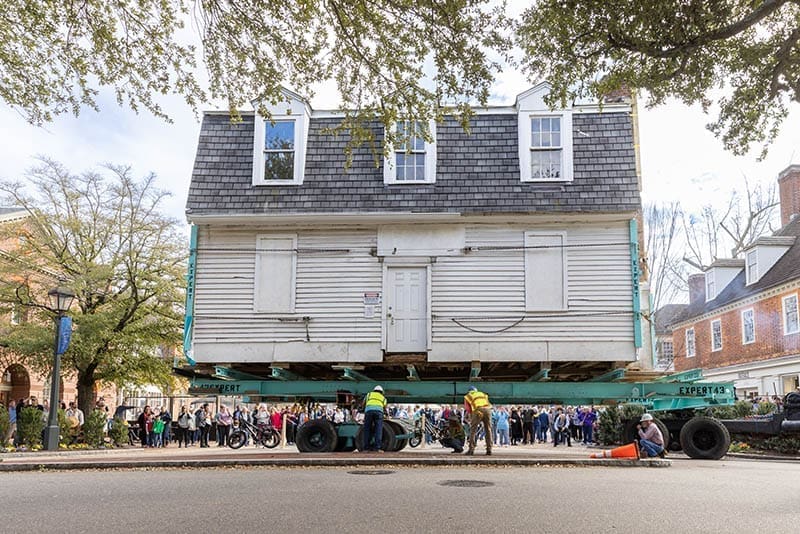
operational from 1760-1774, was unconfirmed until 2020. The building has since been moved and restored.
The school originated from an Anglican missionary organization called the “Associates of Dr. Bray,” which also opened several similar but short-lived schools on the East Coast. Though the existence of the school in Williamsburg was known to historians, its exact whereabouts were something a mystery until recently.
In 2020, researchers used a process called dendrochronology, which analyzes wood samples to determine the age of archeological artifacts, to confirm that the Bray-Diggs House on the campus of William & Mary was the original home of the Bray School. By that time, the building had been utilized for a variety of purposes and was moved in 1930 to make room for a dormitory.
In 2023, the Bray School was painstakingly moved again, this time several blocks to its current location to make it more visible and accessible to Colonial Williamsburg guests. And, although great care has been taken to restore the building to its 18th-century appearance and to understand how it was used and why, there is still much to learn.
“We were faced with an issue of how to interpret a space that is being used both as a living space and as a school,” explains J. Grahame Long, Executive Director, Collections, and Deputy Chief Curator, of the decision to interpret one of two main rooms on the first floor as a classroom with books, basic supplies and furniture, which would likely have been purchased secondhand at the time, and the other as a parlor. Interpretations of exactly how the school would have looked and operated will undoubtedly evolve as new information emerges.
“One thing that fascinates me about this business is how quickly things change,” Long says. “A document shows up or staff finds a chair rail buried in part of the house somewhere and that changes the entire way of looking at it. So, you’ll hear words like ‘yet’ and ‘so far’ a lot because it only takes one little discovery.”
Beyond books and benches, historians also hope to discover more about the seemingly paradoxical motivation of slave owners who sent enslaved children to attend the school, providing them with educational experiences on the one hand but subscribing them to religious doctrine that justified slavery on the other.
There is an identified community of decedents of the Bray School’s pupils, some of whom have been involved in the process of bringing the school to life for the public and whose names were signed inside the walls of the building as it was being restored. A variety of public programming and events tied to the Bray School is being planned for 2025 and beyond.
Learn more at colonialwilliamsburg.org.

Leona Baker
Leona Baker is the former Editor-in-Chief of Coastal Virginia Magazine. She is a writer, creative, communications professional, food freak, news junkie, nature and travel lover and mom. She holds a degree in English from James Madison University and a degree in Dance & Choreography from Virginia Commonwealth University. She previously served as Senior Copywriter for Spark 451, Director of Marketing & Communications at Virginia Wesleyan University, and Senior Editor of Port Folio Weekly.