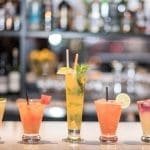
GLASS LIGHT CHEF Tichafa Chingombe TAKES GUESTS ON A SEVEN-COURSE TOUR OF SOUTH AFRICAN DISHES
By Marisa Marsey / Photo above by Misty Prewitt of Misty Saves the Day
One evening in early May, Tichafa Chingombe prepared a lavish wine dinner at the Glass Light Hotel & Gallery. That’s not unusual. Since becoming executive chef in 2024 at Downtown Norfolk’s foremost boutique hotel, part of Marriott’s distinctive Autograph Collection, he’s dazzled diners at many high-profile events including Dinner with Peter Bremers, fêting the renowned Dutch artist whose whimsical, larger-than-life glass bunnies act as Glass Light’s mascots.
But this time it was different. It was personal.

The spring affair, on the cusp of his 36th birthday, entitled A Taste of Home, was a seven-course compendium of South Africa’s most beloved dishes. It could have doubled as a memoir of his formative years, translated into haute cuisine.
“Cooking that day brought back strong memories,” said Chingombe, who has a smile nearly as broad as his shoulders, professorial eyeglasses, and bracelets he rarely removes, representing different chapters in his life’s journey.
He was born in Zimbabwe and grew up amid the country’s calamitous economic crisis. When he was 13, his parents sought work in neighboring South Africa, leaving him to care for his younger siblings. Every day, he made sure that their school uniforms were clean and that they were fed. He discovered joy in cooking despite scant money for the market.

At 16, Chingombe joined his parents in Khayelitsha, an impoverished ghetto on the outskirts of Cape Town, where they were forced to share a shack’s single bed. On a train one day, he sat next to a woman who was studying to be a chef. He had never heard of such a thing.
“In Zimbabwe, it’s tribal food; KFC is a good restaurant,” he said.
Chingombe had no funds for school, but he had gumption. He strode into the kitchen of Fountains Hotel, known for massive buffets, and asked for a job. “The only thing I had to offer was my hard work,” he said, adding, “And the chef opened his hands to help.”
The classical brigade system would allow him to work his way up, and his guardian angel-cum-chef structured a training program for him. Although it didn’t pay, it fed his insatiable hunger for learning. And his actual hunger: He got to eat whatever he wanted.
Soon Chingombe was hired for paid positions, each a career-engineering steppingstone.
At Beluga, a fine dining restaurant, he encountered fancy à la carte menus and upscale ingredients. “I didn’t even know what a lobster was,” he said. “When chef asked me to go to the refrigerator for something, I prayed someone else would come along so I could ask them to point it out to me.”
At even finer La Mouette, he discovered tasting menus and modern European cooking.
Then came the kind of job culinarians fantasize about: private chef to Saud bin Saqr Al Qasimi, ruler of one of the emirates in the United Arab Emirates. “Working with that type of wealth was eye-opening,” he said of his two years at the royal palace. “Excellence was not optional.”
Eventually his calling led him to the U.S. He met his wife, Olivia, at The Bohemian Hotel in Savannah. “She was front-of-the house, and they asked her to show the new chef around,” he said. “I made sure I left with her phone number.”
In South Florida, he was mentored by celebrity chef Fabio Viviani and celebrated restaurateur Derek Fleming, who coached him on the ins and outs of running a business. But when Olivia became pregnant, he realized he didn’t want to raise a family amid Fort Lauderdale’s flashiness.

Fortuitously, Glass Light, with its sophisticated, contemporary Continental-centered menu, offered a perfect fit for Chingombe’s French fine dining roots. He was impressed with the way culinary creativity could complement its visual art. “The ownership’s vision and genuine love for both the gallery and the restaurant made it feel like something much bigger than hospitality alone,” he said. “I saw an opportunity to be part of something truly special.”
And he fell in love with Norfolk: “It’s unique, not too big, not too small. When I’m stopped at a traffic light, I don’t see more than seven or eight cars!”
Glass Light’s emphasis on frequent wine dinners suited him, too, as he had developed a knack for pairing wine and food while cooking at posh vineyard restaurants in South Africa.
Ian Honaker, a Winebow wine rep, remembers that when he heard the lilt in Chingombe’s voice and found out where the chef was from, he said, “I’ve got some great South African wines, let’s do this wine dinner.” Chingombe replied ebulliently, “Yes. Childhood 2.0!”
E-invites went out for the $150 per-person meal. The attached menu was terra incognita to many recipients. Those so inclined (ahem, yours included) had Googling to do, from umngqusho (crushed maize and sugar beans) to springbok (antelope…wait, I did know that!).
The 22 guests who attended, most already Chingombe fans having supped in the hotel’s urbane dining room, came for different reasons. Kelly Zvobgo of Newport News, a William & Mary professor who relishes sampling new restaurants with her husband Will Huberdeau, hails from Zimbabwe, too. “I even share the same totem with the chef, the zebra,” she said. (No preprandial Googling needed for her.)
Teresa and Alandis Hicks of Norfolk had never been to a wine dinner. “I’m more a scotch, bourbon, beer man,” Alandis said. But along with being foodies, their motto is: “We’re not going to see a museum and not stop,” so the setting for Glass Light’s special events—in the hotel’s adjoining Gallery housing the Perry Glass Art Collection—clinched it for them.
Its two stories display a rotating selection of exquisite glass sculptures by acclaimed artists such as Dale Chihuly and Amber Cowan, but this night those masterworks had to compete against stemware carefully set on one long table.
Soon they would be filled with plush wines predominantly from the Western Cape, leading off with a brisk Steenberg Brut Sparkling Sauvignon Blanc NV to accompany an amuse-bouche of Biltong Croquettes atop a luscious garlic and chive aioli.
“We had no electricity and needed a way to preserve meats,” Chingombe said as he presented a tender, tastier cousin to jerky, cured and air-dried beef mixed with a béchamel-esque sauce, shaped into small orbs, and fried ever-so-gently. He finished the dish with finely shaved biltong, “…to add an extra layer of intensity, texture and visual impact that reinforces the dish’s South African identity.”

De Wetshof Estate “Limestone Hill” Chardonnay 2025’s bright acidity cut perfectly through Steamed Mealie Bread, a buttery cornbread (mealie means maize) inspired by the snack Chingombe’s mother would pack for him to stave off hunger pangs at school. A grownup version, it still felt nurturing.
Honaker noted that the balanced Chardonnay (my fave wine that night), made from vines planted using clonal material from Joseph Drouhin’s Clos des Mouches “sells for a song” compared to its stratospherically priced Burgundian Premier Cru source.
Each course—including the umngqusho bolstering a creamy risotto—elevated humble food of Chingombe’s upbringing, highlighting his impressive culinary command and the multicultural crosscurrents influencing South Africa’s foodways.
The aromatic Southeast Asian spices in Cape Malay Bobotie—turmeric, curry powder, cumin, coriander—spoke to the political exiles and slaves from Indonesia, Malaysia, and India brought to South Africa by the Dutch. Traditionally made with beef or lamb, Chingombe opted to load the egg custard-crowned casserole with duck. “This taste is my GPS,” he said, recollecting how he often slaughtered ducks that his grandmother stewed.
Honaker matched it with Beaumont Bot River Pinotage 2022, saying, “You can’t come to a South African wine dinner and not have Pinotage.” The country’s signature varietal, a cross between Pinot Noir and Cinsault (which used to be called Hermitage there, hence the portmanteau), epitomizes the best of South African wine: old world winemaking with new world fruit power resulting in complexity and freshness.
That Pan-Seared Springbok, served with compressed beets and charred corn, drew oohs and aahs for its stunning, suitable-for-framing presentation, then more exclamations for its succulence. It transported Chingombe back to his boyhood: “We would go to the hunt. I’d kill them with bow and arrows, wrestling them if they resisted. Later, we would eat every part of the animal.”
Naartjie Sorbet with its refreshing tangerine flavor gave us all a chance to catch our breath and sigh, paving the way for Malva Pudding, a grand finale of warm sponge cake soaked in syrup topped with Madagascar vanilla bean ice cream, Italian meringue, and fresh strawberries.
“Why isn’t this on the menu?” a foursome pressed the chef on the spot.
Actually, it’s being added to it.
Many wine dinner dishes impact the dining room’s fare, becoming specials or weaving their way into the regular roster.
So, while this dinner was an intimate reimagining of one chef’s personal and professional odyssey, it transcended time and place. It resonated with those present who, along with future Glass Light diners, will cherish delicious new memories of their own.

Marisa Marsey
Marisa Marsey is a food, beverage and travel writer whose awards include 1st place Food Writing from the Virginia Press Association. A Johnson & Wales University representative, she has sipped Château d'Yquem '75 with Jean-Louis Palladin, sherpa-ed for Edna Lewis and savored interviews with Wolfgang Puck and Patrick O’Connell.