

The NorVa’s Rick Mersel looks back on 25 years of rock stars, legends, newcomers and the next big thing
If there’s such a thing as a lifetime backstage pass, Rick Mersel has earned it. As a longtime concert promoter and Vice President with AEG Live/Bowery Presents, Mersel is best known locally for his work at the NorVa, the historic downtown Norfolk venue, originally opened in 1922, which was reimagined as a concert hall in 2000. Since then, everyone from the Godfather of Soul to Billie Eilish has graced its stage and Mersel has been there to witness it.
But what some people may not know about Mersel is that, at his heart, he is himself an artist, a musician and, maybe most of all, a fan. And, as I discovered recently, he is also a darned good writer. On the occasion of the NorVa’s 25th anniversary, Mersel is about 100 pages into writing a new book in which he recounts his early days collecting records, going to concerts and, like so many music lovers, finding connection and solace in the sounds and songs that define our lives.

The book also details what led to the NorVa becoming a reality and some of the many remarkable moments he has experienced since then alongside staff, concertgoers and the hundreds of artists who have performed there—many of whom were little known at the time but on the verge of superstardom. Here is an excerpt from Mersel’s forthcoming book.
—Leona Baker

“It Was About Being There.”
By Rick Mersel | A Book Excerpt
The NorVa opened in a blaze. James Brown kicked things off with a perfect, surreal, unforgettable moment next to the backstage “Hot Tub.” Matchbox 20 launched their first world tour here. Then there was Prince who called us personally, out of nowhere, to say he was playing the venue on the following Tuesday April 17, 2001. Four minutes. That’s how long it took to sell out. Four minutes.
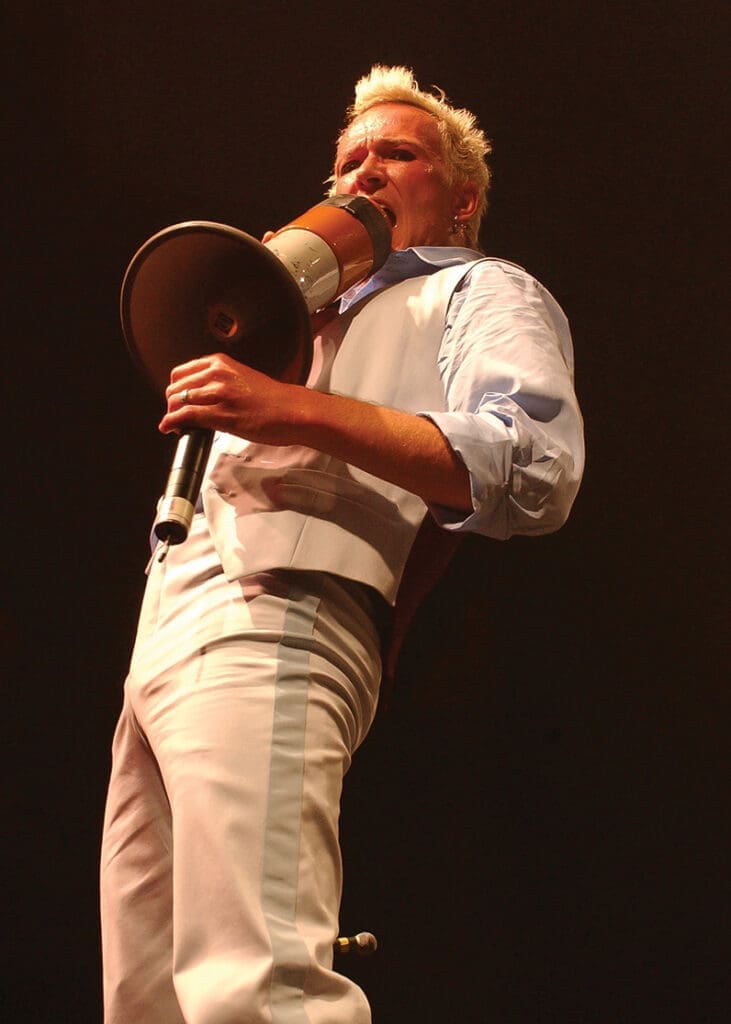
But the one show that still reverberates in my memory was Stone Temple Pilots. The haze was thick with plumes of murky mist rolling out from fog machines we’d positioned around the venue. It was theatrical but also a logistical nightmare. The Fire Marshal hovered close by ensuring no errant bells from the vapor would shatter the rising tension during the chorus of Interstate Love Song.
Then Scott Weiland appeared. A silhouette etched in perfection, the archetype of the Rock God. He was shirtless, defiant, one leg planted on a monitor like he owned the world. He gripped a megaphone appearing as part front man and part general rallying his troops. Together, Stone Temple Pilots unleashed a supernatural set. It was a barrage of sound and sweat. Every riff and beat landed like blows from a sledgehammer. It was like witnessing perfectly choreographed chaos.
It wasn’t just a great show, it was the show. One of the best I’d ever seen. One of those nights where the room, the crowd, and the music locked into some transcendent alignment, making you realize you were part of something you’d be talking about for years. In the history of The NorVa, it stands as legend.
There were moments in the beginning, strange and cinematic, that stand out in memory like freeze-frames from a movie that was never supposed to happen. I had dinner with Ringo Starr, his iconic presence hung in the air. I played golf with Willie Nelson, the smell of the course grass mixing with something more potent. I sat on B.B. King’s bus as he told stories that felt as timeless as his blues.
I had a discussion with Deborah Harry, cool and detached with effortless charisma. I couldn’t help but thinking of Damone from the film Fast Times at Ridgemont High explaining to Rat how-to pick-up girls using a cardboard cutout of the women sitting directly across the table from me. She looked over my shoulder at the Blondie show poster I’d thrown together on an early version of Photoshop, “This is great, who made it” she said. It was a simple compliment, but it lingered and replayed in my head more times than I care to admit. Moments like that didn’t feel real, not then, and maybe not even now. But they happened. I was there.
The NorVa wasn’t just another venue. It was a cathedral of sound, a place where icons carved their names into music history before launching into the stratosphere. It was about discovery, about standing feet away from someone who, in a few years, would be unrecognizable behind layers of stadium-sized production. We had them all before the rest of the world did. Kendrick Lamar. Billie Eilish. Tyler, The Creator. SZA. Post Malone. The Weeknd. Charli XCX. Frank Ocean. Future. Chappell Roan. They stood under our lights, their voices cutting through with their promise of greatness.

There were other artists who defined the times for a fleeting moment like Fall Out Boy who played their first show out of the Mid-West Region at The NorVa. There was The Killers, Panic! at the Disco, Twenty-One Pilots, The Strokes, Death Cab For Cutie and Nickelback.
There were the Country kings and queens whose fans lined up down Monticello Avenue decked out in seldom worn cowboy hats and fresh new boots. These included Blake Shelton, Kane Brown, Jason Aldean, Luke Bryan, Kacey Musgraves, Sturgill Simpson and Miranda Lambert. Disturbed, Slipknot, Slayer, Avenged Sevenfold, Shinedown, The Deftones and Breaking Benjamin also performed tapping into the undercurrent of metal and rebellion that never really goes out of style.
Of course, there were the legends who performed at The NorVa. Bob Dylan sat stoic behind a piano with his raspy poetry. Iggy Pop prowled the stage on Halloween, the house lights glaring down on the crowd with an unforgiving brightness. Lou Reed, appearing detached and enigmatic, let his performance unfold like a slow, deliberate hallucination. Alice Cooper and his musical descendent Rob Zombie each performed separate shows both equally theatrical and menacing. Each dark carnival impossible to forget.
The list felt endless, a revolving door of immortals passing through, each leaving behind the echo of something larger than themselves. The Doors, still potent in their eerie mysticism. Gregg Allman, haunting and soulful, his voice a lingering ghost. George Clinton, a cosmic force barely contained. Elvis Costello’s sharp wit cut through the air like a switchblade, while Billy Idol sneered and pulsed with electric defiance.
Snoop Dogg floated in, effortlessly cool, his presence a study in fluidity. Jack Johnson exuded a breezy nonchalance. Jethro Tull leaned into the mystical, while The Pretenders radiated a pop-punk defiance.
Joe Cocker rasped his way into the room, a voice still dripping with the raw grit of the ‘60s. Justin Timberlake arrived polished and precise, while The Jonas Brothers embodied pop stardom in its purest form. Bob Weir tapped into the soul of the Deadheads, weaving nostalgia with the present. Pat Benatar’s voice, still razor-sharp, sliced through the air.
And then there were The Smashing Pumpkins, Wu-Tang Clan, and The Pixies. Each a different shade of rebellion, a sonic collision of art and anarchy.
Each of them, for a moment, belonged to The NorVa. Each left their imprint, a fleeting spark in the ever-burning fire of music history.
The NorVa was never only about the music. It was about being there, about saying you were there, about claiming a tiny piece of the mythology before the artists were swallowed up by stadiums and arenas. It was also about being feet away from legends you had listened to all your life.
The NorVa isn’t just a venue. It’s a statement. A refusal to accept the ordinary. A place where music, real music, can still happen.
Learn more and find a current concert schedule at thenorva.com.

Leona Baker
Leona Baker is the former Editor-in-Chief of Coastal Virginia Magazine. She is a writer, creative, communications professional, food freak, news junkie, nature and travel lover and mom. She holds a degree in English from James Madison University and a degree in Dance & Choreography from Virginia Commonwealth University. She previously served as Senior Copywriter for Spark 451, Director of Marketing & Communications at Virginia Wesleyan University, and Senior Editor of Port Folio Weekly.