
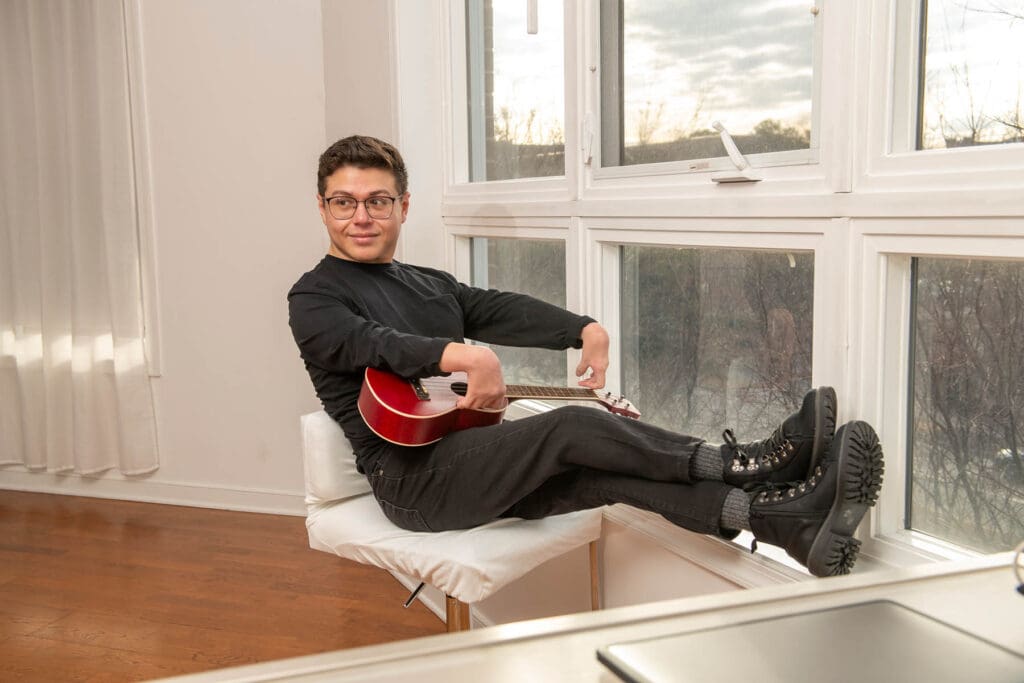
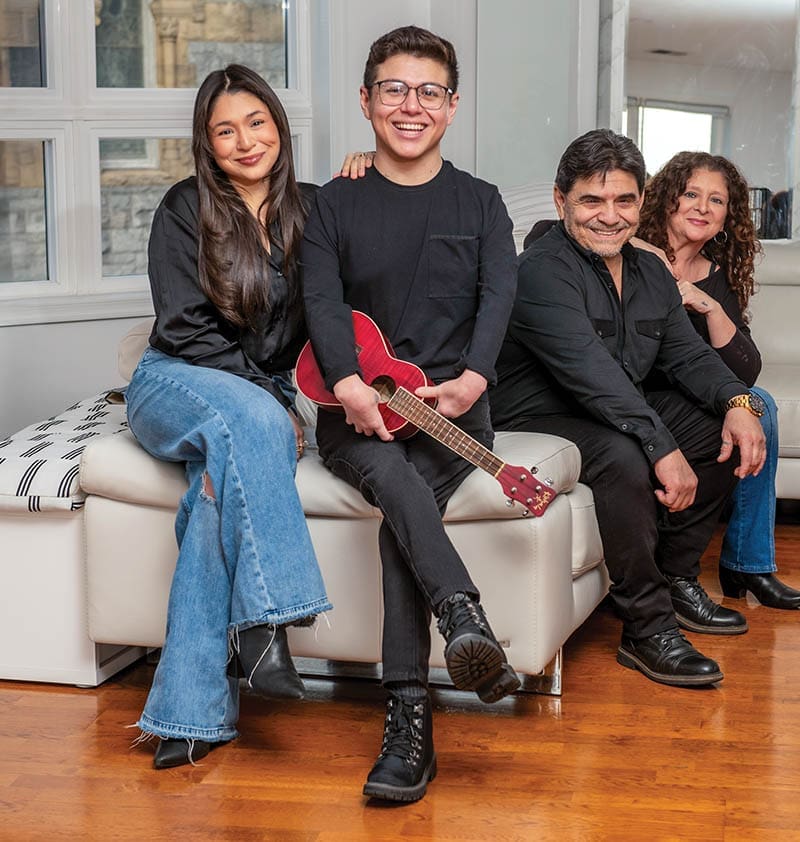
Norfolk singer-songwriter Brandon Vera, whose Artist name is BRNDN DYLN, figured out his own way to perform the piano and ukulele with a congenital joint disorder and is honored for his artistry.
Story By Butch Maier | Photos By David Uhrin
As soon as Brandon Vera was born in a Norfolk hospital in 1993, his new parents were distressed. “It was very noticeable,” Sandi said. Her baby—surprisingly—had clubbed hands and feet. “Then I saw my husband’s reaction,” Sandi said. Robert stood there, stunned. “I didn’t know what to think,” the new father said. “I asked the doctor, ‘What is this? What is this? Why is he like this?’ That’s all I remember. Then, all of the sudden, something came over me.”

The confused dad fainted. “I woke up with a priest next to me,” Robert said. “He was giving me the notion of, ‘This is what God wanted.’ At that point, I was angry.” Doctors determined Brandon had a type of arthrogryposis multiplex congenita (AMC). “We were not prepared,” Sandi said. “They had not told us. And the tests that they did, it never came out that Brandon had anything.”
According to the National Organization for Rare Disorders, AMC “is a term used to describe a group of congenital (present at birth) conditions characterized by joint contractures in two or more joints of the body. Therefore, AMC is a descriptive term for over 400 different conditions rather than a single diagnosis.”
In simpler terms, Brandon had multiple curved joints. His parents brought him home from the hospital with tiny casts on his little legs.
“Like all parents, you have this very idyllic view of what your child’s life could look like,” said Brandon, now 32. “But then another possibility presents itself.”
Another possibility presents itself.
While the world often dwells in impossibility, Brandon has lived a life of possibility.
‘I COMPLETELY STARTED SOBBING’
A friend this year told Brandon, now a singer-songwriter who performs as BRNDN DYLN, about The Danny Awards. Brandon did not initially spend much time considering a submission for the Daniel’s Music Foundation show, which recognizes the contributions of artists with disabilities from across the globe.
Anyone in the world can submit a video of one of their performances. What are the chances he would be selected? Still, Brandon thought on it some more and figured he had nothing to lose.
It is possible.
He submitted a piano-and-singing cover of Emily King’s Distance. “Then I kind of forgot about it,” Brandon said. Then he received a call. His father was cautious. “At first, for me, it was, ‘OK, what are they trying to do?’” Robert said. “Because you never know these days. Some people are scamming people. I didn’t want my son to be a victim.”
Rather than a victim, Brandon was a victor. “I completely started sobbing,” Brandon said. He was selected to perform in New York in October and be honored at The Danny Awards—the first time he had been recognized for his musicianship as a solo artist.
Despite everything he has endured physically, Brandon’s life has been measured by a steady string of victories. Regardless of his circumstance, he has never been a victim or played a victim. He just keeps playing.

‘HE PROVED EVERYONE WRONG’
When Brandon was born, a specialist was called in to talk with the baby’s Ecuadorian parents.
“From the start, I guess they tell you the worst,” Sandi said. “He said that Brandon probably wouldn’t walk.
“Little by little, he proved everyone wrong.”
Nothing could keep Brandon from crawling. Surgeries followed. More casts. Leg braces. Some mothers would be overwhelmed. Sandi had help from a son who kept chugging along. The little infant who could.
“He made my life easy,” she said. “It wasn’t difficult at all. He was such a good baby.” The first year of his life, Sandi took Brandon to the hospital every two weeks. Every two weeks. His casts had to be changed that often so the bones could grow in a way that would benefit Brandon. “So they wouldn’t bend any more than the way they were,” Sandi said. The outcome of the initial casting process was not ideal. Doctors needed to surgically reconstruct his feet. The first foot surgery was at 9 months of age, the second at 12 months. “After that, he had a couple more surgeries for his feet and legs,” Sandi said. An important question loomed: What about his hands?
ORDINARY PEOPLE
Robert and Sandi were presented with the risky option of hand surgery on young Brandon.
“His hands, we never wanted to touch because they did tell us it was a 50-50 chance,” Sandi said, “and we didn’t want to take that risk of him losing what he could do with them.”
Because no surgery was performed, his hands remain curved. Because of no surgery, he can perform. He not only plays the piano but the ukulele, too.
His is not a progressive, chronic condition.
“Looking at me, I think a lot of people assume I am always in pain because of the way my bones are structured,” Brandon said. “But there’s no pain involved. It’s just that’s how I aesthetically look.”
Looks, of course, can be deceiving.
“[Doctors] didn’t think that he would have too much mobility in his hands or his fingers,” said sister Gigi, 27, who also lives in Norfolk. “Because he still has curved hands.”
Brandon has been showing doubters what he could do his entire life.
On his timeline. In his own ways.
The possibilities.
Brandon did not take his first steps until he was 2. That was also when he played his first musical notes. Robert owned an electronic keyboard and placed it on the floor.
“He would just go there and start hitting it and playing it,” Sandi said.
The keyboard seemed to have a magnetic force that attracted Brandon.
“From that moment, I’ve always gravitated toward the piano,” he said. “And I remember hearing the song Ordinary People by John Legend:
We’re just ordinary people
We don’t know which way to go
’Cause we’re ordinary people
Maybe we should take it slow
“When I first heard that song, I really wanted to learn how to play piano,” Brandon said.
WHAT A WONDERFUL WORLD
Robert wanted to make sure the house was always filled with music.
“I think my musical journey began with my father,” Brandon said. “He loves karaoke. Ever since I was a child, starting in the womb, he was singing to my mother whenever he could. And when I was born, he would hold me and sing karaoke for hours.”
Dad would cook breakfast and wake his kids with disco tunes.
“Right when we were out the womb, my dad was just ready to get us into that world of enjoying music,” Gigi said.
Robert often would sing Louis Armstrong’s What a Wonderful World to his toddler son. Brandon quickly picked up the words.
The family embodies the positive perspective presented in the song’s lyrics:
I hear babies cry
I watch them grow
They’ll learn much more
Than I’ll ever know
And I think to myself
What a wonderful world
“Even though he was born with his disability—which, to me, is not a disability,” Robert said. “I wish I could play the piano the way he plays the piano.”
“Or the ukulele,” chimed in Sandi, who doubles as Brandon’s manager.
“I always push for him to not let this God-given disability stop him,” Robert said.
The family moved for a time to Virginia Beach, where Brandon’s parents still live, and young Brandon sang in a Landstown Elementary School talent show.
His song of choice? What a Wonderful World.
From time to time, his mother—who stayed home during the kids’ childhoods to care for Brandon and Gigi, who has Type 1 diabetes—revisits a recording of the performance and tears up.
“It does get to me,” Sandi said, “every time he says, ‘This is for my mom.’”
WALKING AND DRIVING
Even after Brandon began walking, medical specialists were doubtful how far his feet could take him. They thought Brandon only would be able to walk very short distances.
“He quickly debunked that,” Gigi said. “He proved all his doctors wrong.”
The family often traveled to New York—Brandon’s dream city—to stay with extended family.
Gigi said Brandon was determined to prepare for life there, telling her, “‘I have to get up, and I have to walk if I am going to be a New Yorker at any point in my life.’ He was literally walking everywhere.” Not that he has to. Brandon has been driving since age 16 with no special amenities in his car. “I argue that he’s a better driver than I am,” Gigi said.
LEFT TO HIS OWN DEVICES
As a kid, Brandon had devices to help him slip on his shoes. “I’ve phased out certain things because I’m very stubborn,” he said, chuckling. Now he is selective of which shoes—usually Nikes—to try on that are easier for him to put on and tie without assistance.
“If I don’t have the adaptive equipment, sometimes some of that equipment can be expensive,” Brandon said. “And sometimes [health] insurance is kind of finicky about what it will cover. So, in my mind, I was like, ‘I need to adapt to a world that wasn’t necessarily built for me.’
“I think any disabled person or even parent of disabled children can understand how insurance companies are…” He paused to choose his words carefully. “I think there are a lot more conversations that need to be had because sometimes insurance companies go off of these templates for disabilities that are not the same at all,” Brandon continued. “Even if it’s under the same umbrella. They can be vastly different from each other. For example, I have arthrogryposis, and it’s a rare condition that has about 400 varieties. But, you know, we’re still put under the same umbrella of, oh yeah, we all have arthrogryposis—yet we all have different situations. Even able-bodied people. Just because those individuals may not have a disability, the approaches of how to navigate life are going to be different.
“No matter whether we have a disability or not, we present so differently in our existence in so many ways, and I just feel like when a lot of things are put into a template like insurance companies have—which I am sure are important for certain things—when it comes to disabilities, I think there needs to be better discernment on how they are serving us.”
FINDING WAYS TO PLAY
Most people start playing instruments the same way. Teachers show students the basics—telling them where to place hands and where to position fingers. Students try instruments, see if they like them, and determine if they want to continue playing. Brandon started playing instruments to see if he could physically play them at all.
Was it even possible?
His parents found a piano teacher who taught him the fundamentals for a year. Still … “I couldn’t do the able-bodied approaches to playing the piano,” Brandon said. “I had to figure out my own adaptive ways.”
He had to discover how he could deconstruct the piano arrangement and perform the instrument in a manner that was accessible to him. “When I am using an instrument, I first assess: ‘Is this accessible to me?’” he said. “I see if it is within my ability to do where I could play. And once I go, ‘Oh, I think I can really play this,’ I go very hardcore intensely and try to learn everything about it so I can be as good as I can on an instrument.”
He settled on the piano and the ukulele as his two main instruments of what he could play and what he enjoyed playing.
“Whenever I play an instrument, I use my music theory knowledge—or anything that I have learned in music—to adapt the arrangement,” Brandon says. “For example, with my left hand, I only have my most functionality with my left index finger. I’ve learned to have quicker speed when it comes to my left hand, in how I create the rhythm, in terms of the bass notes. And then my right hand, I have functionality mostly in my four fingers, excluding the thumb. I use that for any sort of chord structures to supplement the bass notes.
“Altogether, it sounds like a very complete piece, and I am still hitting all of the root notes that are needed. That makes sense to the listener when they listen to the song, so it sounds very similar, but obviously, I’m deconstructing it in a way that I can still achieve a similar sound to what it needed for the song.”
Brandon graduated from Landstown High School. He earned bachelor’s and master’s degrees in communication with an emphasis in marketing from Regent University. He moved back to Norfolk after college and works in the nonprofit sector. He and his sister also are working together on a marketing and branding business.
‘THIS NATURAL SMILE’
Brandon grew up performing at numerous talent shows with Gigi. She thinks the world of him. “He’s such a social butterfly,” Gigi said. “He’s so charismatic. I always describe him like a golden retriever because he has this natural smile on his face. He’s not somebody you would fear walking up to. He’s not intimidating.
“He’s just so warm of a person. And quickly, you start laughing with him. And you kinda crave being around people who are that bubbly.” So, when Brandon FaceTimed her at work and was sobbing, Gigi panicked. “I was terrified,” she said. “My brother, he’s what I consider my rock. He’s not a very emotional person, in terms of, like, he’s not a big crier. I’m the complete opposite. “I was like, ‘What happened? What’s going on? Do I need to come get you?’”
Brandon’s tears had preceded the reveal of the good news: Her brother was an award-winning performer. “Dude, you can’t do that!” Gigi said of the delayed surprise. The possibility of The Danny Awards had become a reality.
“Obviously, it was great news, and we were so proud of him,” Gigi said. “But I could not get much out of him because he was sobbing.”
The details that eventually followed just got better and better:
• Brandon had won a trip to New York.
•
He would perform at Grand Central Station, where a crowd formed for a group karaoke singalong, and commuters would intentionally miss their trains just to keep singing with him.
•
He would spend time in workshops with people from the Grammys.
• He would land a musical mentor.
Knowing how many possibilities just opened up for him is why he could not stop crying. “Usually, I am pretty good at keeping it together,” Brandon said, “but at that moment, it just shook my heart so specifically and very directly about what I am very passionate about, so I was completely shocked.”
NOSTALGIA TOXICA
BRNDN DYLN has published 44 original songs. He has written 300 others that are as-of-yet unpublished.
“I think, unfortunately, I’m mostly a perfectionist, so it’s hard for me to release something until I feel good about it, which takes a bit,” Brandon said.
He describes his music as “a mix of pop, R&B, and indie with Latin influences.”
Brandon’s debut, Nostalgia Toxica, a mostly Spanish album, translates to—you might have guessed—“Toxic Nostalgia.”
“I wrote that album mostly out of needing catharsis from my dating life,” Vera said. “What I like to do with my music is I write about my experiences as a disabled person, but about topics that are often taboo because I think there’s not enough content out there about being disabled but also wanting to date, wanting to be in relationships—what does intimacy look like.
“These are conversations that are often talked about with people who are able-bodied, but what does that look like in the context of having a disability? What do intimacy complications look like when you have a disability and you have to go a different way about establishing relationships?
“All of that looks different from a disabled person’s point of view.”
His favorite of his songs is a Spanglish indie pop tune called Black Magic. TikTok has been the magic ingredient for getting Brandon’s music out there. Two ukulele cover songs he performed—Ochii Astia Verzi by Jamarr and Love Me Not by Ravyn Lenae—have surpassed 1 million views each on the platform.
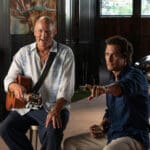
Someone at Apple noticed him on social media and invited him to perform in a short video. Accessibility: I’m Not Remarkable amassed 22 million views in its first two weeks. Perhaps some artists of note now will take note.
‘DREAMS NO ONE
COULD STEAL’
Brandon grew up in Virginia Beach a generation after musician-producer Pharrell Williams. Brandon has designs on following in Pharrell’s footsteps—or perhaps even walking beside him. “I really love Pharrell’s approach to music production,” Vera said. “I would love to collaborate with Pharrell, whenever that is possible.” Whenever that is possible.
Some might look at such a dream collaboration as impossible. Not Brandon. As poet Emily Dickinson did before him, he dwells in possibility. He lives two lines from one of his favorite songs, The Eagles’ Lyin’ Eyes:
On the other side of town,
a boy is waiting
With fiery eyes and dreams
no one could steal
Dreams of producing more of his own music. Of collaborating with the best. Of producing music for other local artists.
“I really, really love the behind the scenes of engineering music and the creation of music,” Brandon said. “I think that’s where my happy place is. I would love to produce more at a very high level and be one of those sought-out producers to produce other artists.
“The other main goal is I definitely want to serve as representation for other disabled musicians or even the disability community in general. I grew up not having a role model, necessarily, or examples of what living life to the fullest can look like.
“I think my main reason to push the envelope in ways that I can is I want to make sure that I communicate that in spaces where we feel excluded, we can create the space there without anyone’s permission.”
He has grown to realize the possibilities of building something new are endless.
“I always felt like I had to abide by, ‘Oh, if it doesn’t exist, then I cannot create it,’” Brandon said. “I think I am at a point now in my 30s where, ‘Oh, it doesn’t exist? I will create it then.’
“And that’s the mentality I’m trying to shift to. My mentality and how I think now could never have been developed without my parents as well as my sister.
“The communication, or messaging, toward people with disabilities or chronic illness has always been one of contextual limits: We can’t do this. If we do this, it’s a huge risk. So, on top of the communication of risk management, it just feels like we are constrained to just narrow opportunities. But my parents have always—and maybe it’s because of their Latin roots—been very strong individuals.
“It starts with me being first-generation Latino [American]. I’ve grown up in a context of: ‘It’s not impossible. You just need to find a unique way of getting there, and it is possible.’”

Butch Maier